|
GO PADDLE No. 31 · SAFETY
All About the Leash
Lakes, seas and rivers: choosing the right leash for the water, and wearing it right
|
||||||||||||||||||||||||||||||||||||||||||||||||||
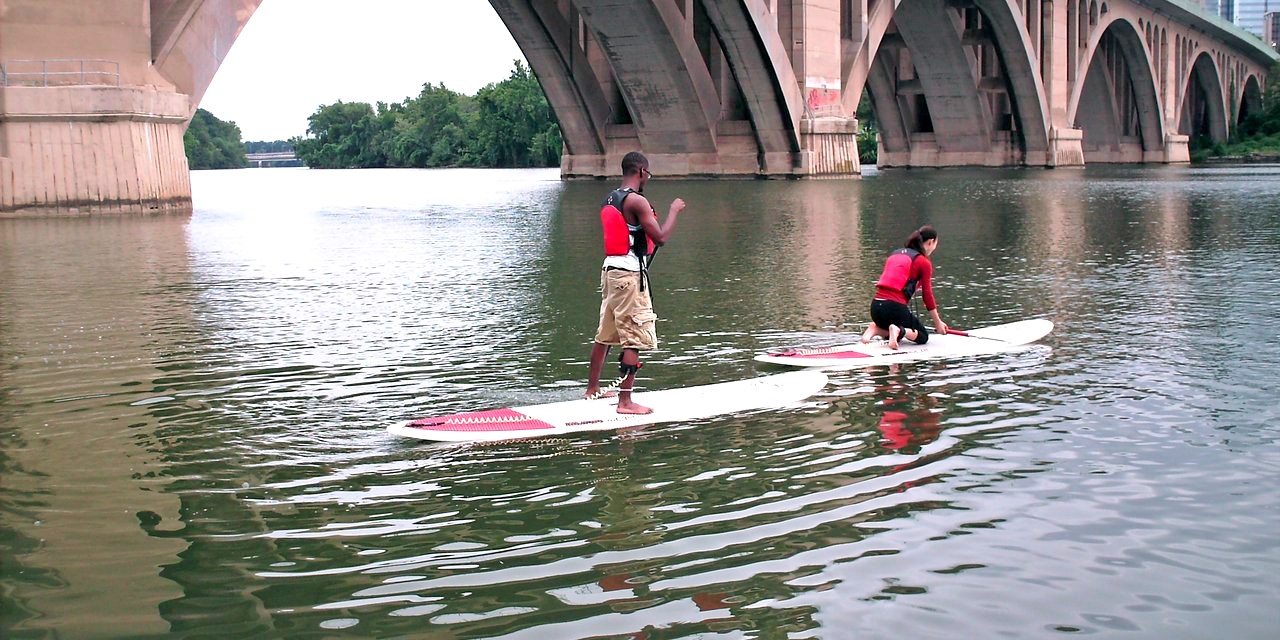
SUP paddlers on the Potomac River, Washington, D.C. · Aug 2013 · Photo Ben Schumin · Wikimedia Commons source · CC BY-SA 2.0 · cropped, brightness and saturation adjusted
|
||||||||||||||||||||||||||||||||||||||||||||||||||
| 🌐 한국어로 보기 | ||||||||||||||||||||||||||||||||||||||||||||||||||
|
Hello from GO PADDLE 👋
Where and how do you wear your leash? 🤔 Most people think "just put it on and you're fine." But depending on the water and where it's attached, a leash can be the lifeline that saves you or the snare that holds you under. So in this issue we take a close look at the cord that ties you to your board: the leash 🦺 We cover leash-related accidents, how to choose and wear a leash for each kind of water, the numbers behind SUP accidents, and what Korean law says about leashes, with a look at Seoul's Han River. |
||||||||||||||||||||||||||||||||||||||||||||||||||
🕯️ It keeps happening
In an earlier issue on paddling in the wind, we called the leash a lifeline. On calm lakes and seas that is still true. Your board is the safest float on the water.
But on moving water, the same cord can hold you under. That is why where and how you wear it matters. We put this together in memory of those who died in leash accidents, so that it does not happen again 🕯️ |
||||||||||||||||||||||||||||||||||||||||||||||||||
|
🌲 July this year: an ankle leash snagged on the Willamette
July 14, afternoon, on the Willamette River in Oregon, USA.
A 26-year-old paddling downriver with a group hit a submerged tree and fell off his board. The leash on his ankle caught on a branch, and he could not get free.
Rescuers reached him and took him to hospital, but he died. 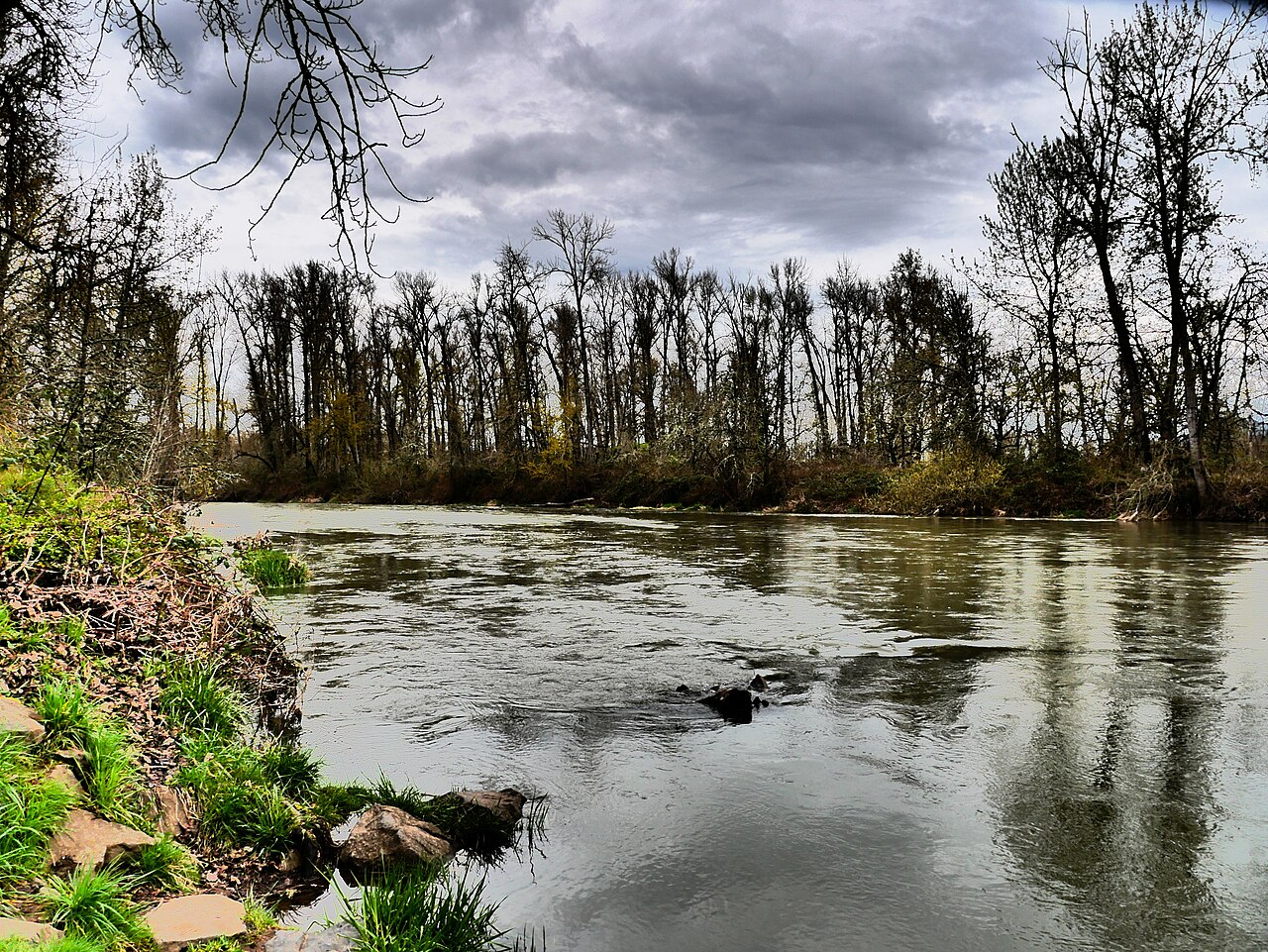
The local sheriff's office urged:
It was not the first time in Oregon.
Every leash-related death in Oregon since 2020 involved an ankle leash. |
||||||||||||||||||||||||||||||||||||||||||||||||||
|
📍 Summer 2024, the same river
Two summers ago, something similar happened here.
In July 2024, Naomi Pomeroy, a well-known chef from Portland, was floating downriver with two companions, their inner tubes and SUP board tied together. The SUP board was attached to Pomeroy's body by a leash.
They snagged on a tree sticking out of the water. Her two companions got free and were rescued, but Pomeroy was held by the leash attached to her body and never resurfaced. After the accident, authorities left a lesson every paddler should remember:
|
||||||||||||||||||||||||||||||||||||||||||||||||||
|
🏴 The tour that stopped below a weir
The UK's worst SUP accident also happened on moving water.
Haverfordwest, Wales, October 2021. On a day with a flood alert in force, a paid SUP tour led by a local company went down the river and over the town weir.
Trapped in the recirculating water below the weir, four people died. 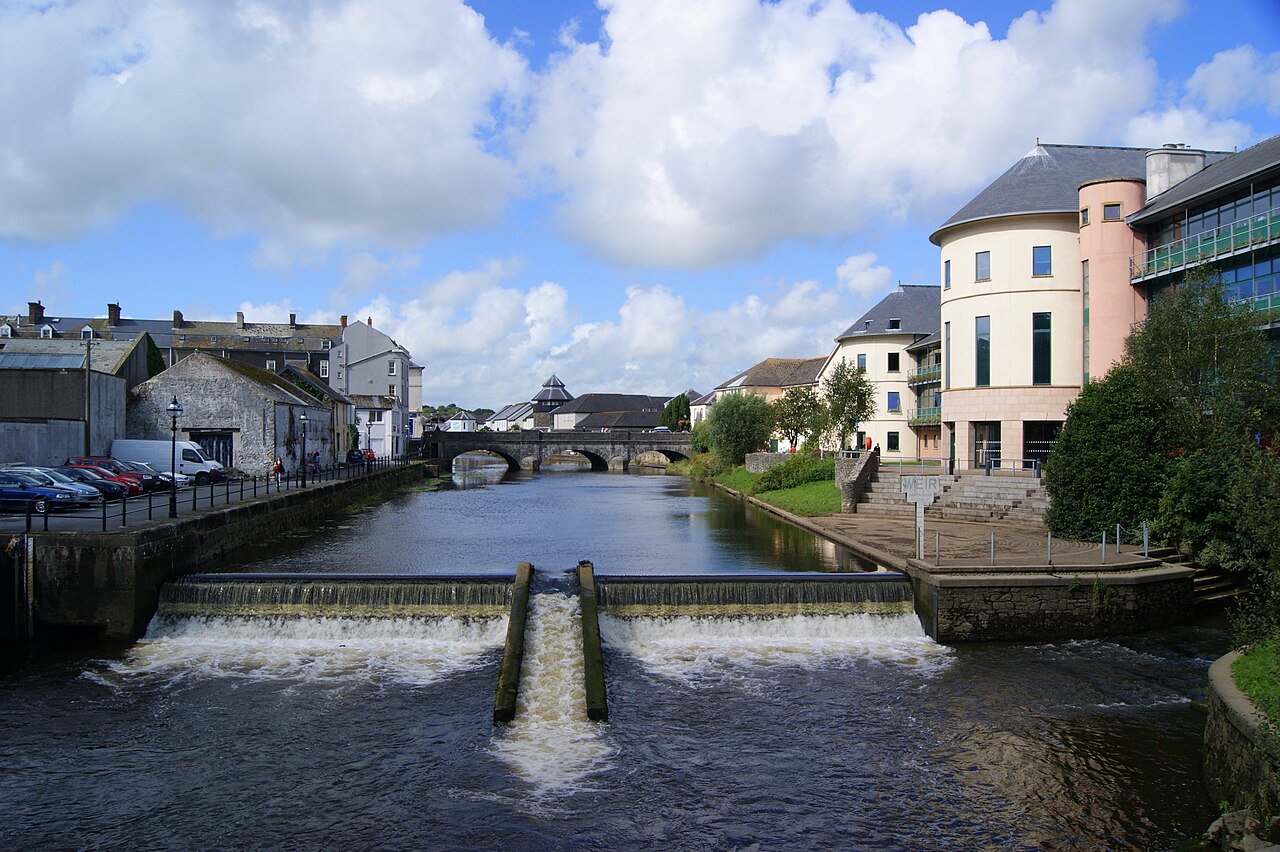
The weir on the Western Cleddau in Haverfordwest — it looks low, but the water below recirculates · Aug 2012 · Photo Pam Goodey · Wikimedia Commons source · CC BY-SA 2.0 Most of the group were using ankle leashes. The accident investigators said this may have reduced their chances of survival.
Their conclusion — "On moving water, a quick-release waist leash." The tour company's owner admitted gross negligence manslaughter and was jailed for 10 years and 6 months. In June this year, an appeal to reduce the sentence was rejected.
The judge called the basic safety management "woeful." For those of us who run lessons and tours, this ruling is not someone else's story.
Which leash a participant wears into the water is the operator's responsibility. |
||||||||||||||||||||||||||||||||||||||||||||||||||
|
🌊 Lakes, seas, rivers: the right leash depends on the water
Not all leashes are the same. There is the coiled leash, curly like an old phone cord; the straight leash; and the waist leash, worn around the waist.
Which one to use depends not on your skill but on the water. |
||||||||||||||||||||||||||||||||||||||||||||||||||
|
🏞️ Calm lakes and seas — coiled leash
A coiled leash stays off the water, so it does not drag and is less likely to snag your feet.
Paddle UK also recommends a coiled leash for general SUP. 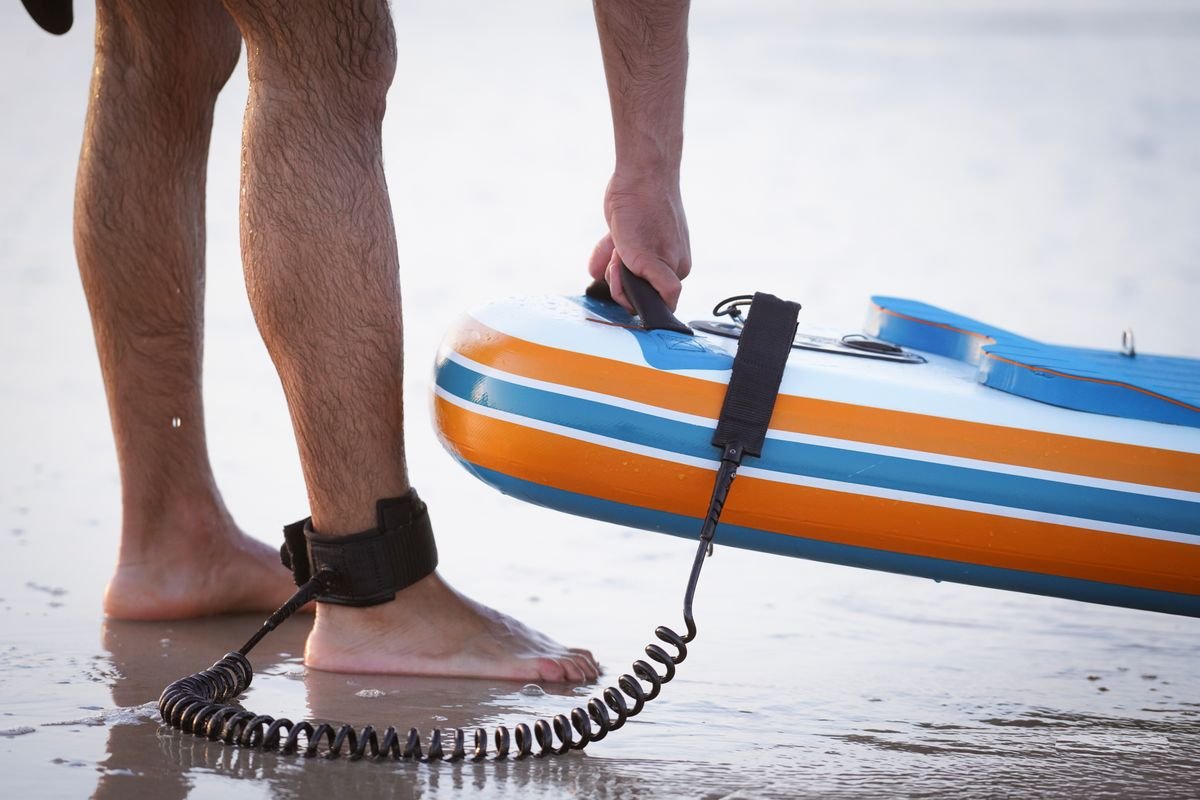
Coiled leash — for calm lakes and seas; the coil keeps it off the water · Photo Samer Bououd · Pexels |
||||||||||||||||||||||||||||||||||||||||||||||||||
|
🏄 In the surf — straight leash
The sea with waves is a different story. When a wave drags the board away, a coil stretches and snaps back like a rubber band, and the board can fly back at you.
That is why gear makers say to use a straight leash, not a coil, in the surf. It is why surfboards come with straight leashes, and the same rule applies when you surf a SUP. 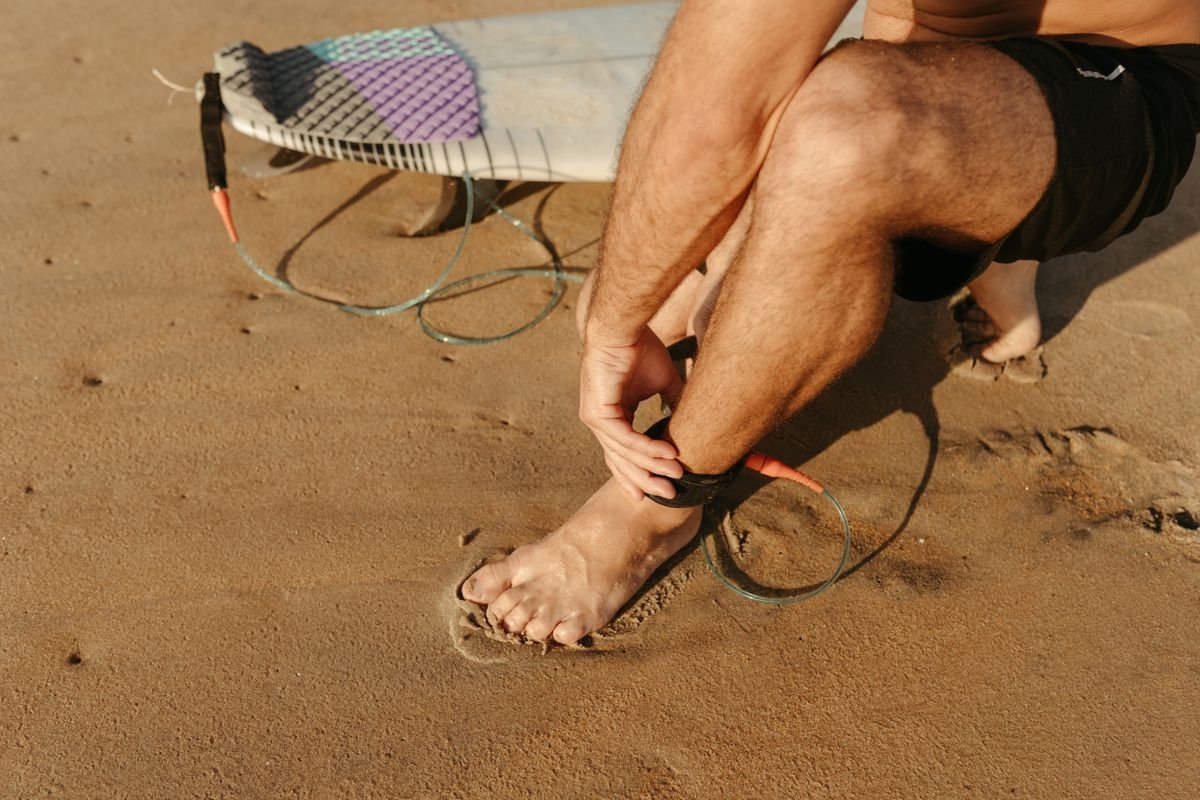
Straight leash — for the surf (surfing and SUP surfing); it stretches but does not spring back · Photo Jonathan Borba · Pexels A board springing back can cause serious injury.
Jack O'Neill, who made the first wetsuit, lost an eye to a board pulled back by an early rubber-cord leash. Australian pro surfer Derek Hynd also lost an eye when a board sprang back at him during a 1980 contest (Stab Mag interview). Both were surfboards. A SUP board is far bigger and heavier, so the impact would be greater 💥 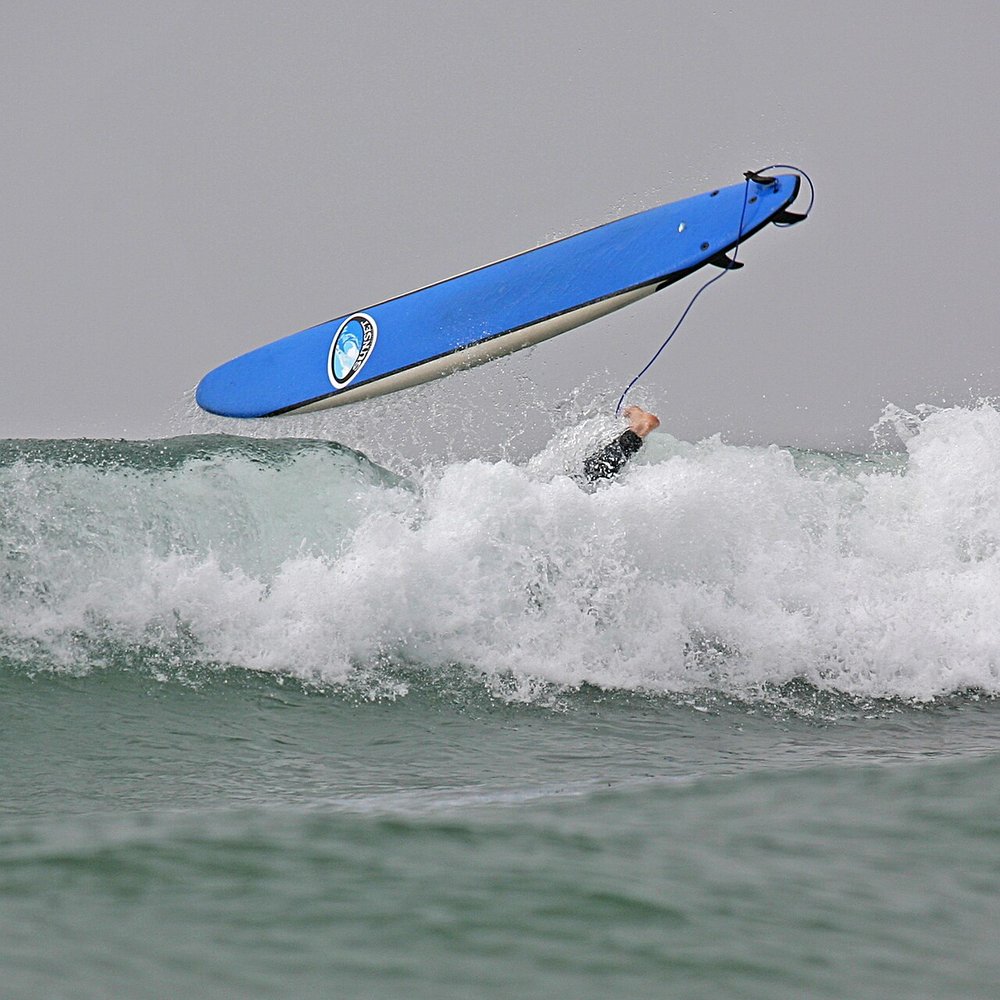
Leashes snag at sea too.
In June 2024, a 47-year-old surfer did not come back from a reef at Margaret River, Western Australia. Surfers with him said his board was floating upright on the surface. The coroner could not determine the cause of death, but police thought it likely that his leash had caught on the reef and held him down. There have been leash-related accidents in Korea as well. In August 2023 a surfer in his 50s died at Yangyang, and the Korea Coast Guard believed the cord linking the board and his ankle had broken (Insight, Aug 15, 2023).
Leash accidents are rare, and in most waters a leash saves lives. Still, you should always be ready for it to snag or break. The gear retailer evo also warns that leashes can break, so don't count on one as a lifesaving device, and don't paddle out farther than you can swim back (evo). In the end, accidents happen when the leash doesn't suit the water, and when a worn or loose leash is used without checking it. |
||||||||||||||||||||||||||||||||||||||||||||||||||
|
🚣 Moving water — quick-release waist leash
On moving water such as rivers, estuaries, and fast tidal channels or harbor mouths, an ankle leash that snags is hard to free yourself from. If the leash catches on a branch or rock while the current carries you, your body is pulled downstream and your foot is pulled back. In that position, you can't reach your ankle.
So a quick-release leash worn at the waist, within easy reach of your hands, is recommended. That was the authorities' conclusion after the UK accident too. But not every waist leash is quick-release. Most waist leashes on the market are Velcro belts. When a snagged leash pulls hard, the Velcro grips even tighter, so it is hard to tear free in a current. On moving water you need a quick-release waist leash that comes free in one pull of the toggle on the buckle. Check for a release buckle and pull toggle before you buy. So is quick-release enough? Not always.
In 2023, British Canoeing (now Paddle UK) tested quick-release waist belts 130 times on a flowing channel.
Four times in ten (42%), they did not release cleanly. The buckle was stiff, slow, or hesitated partway. But when the belt was sized to the body, the spare webbing was trimmed, and testers were taught to punch the toggle away from the body, that rate dropped to 10%.
Wearing it properly and practicing the release matter as much as the gear itself 💪 The same tests showed one more thing. When a leash caught underwater, a buoyancy aid did not bring the body fully to the surface.
A buoyancy aid can't beat a snagged leash. So on moving water, the first job is choosing a leash that won't snag, and releases at once if it does. |
||||||||||||||||||||||||||||||||||||||||||||||||||
|
🧲 A leash that releases itself
There is now a leash that comes free without you pulling anything: the magnetic auto-release leash from Lodestone Leashes.
A magnet sits in the middle of the connector, holding it together while you paddle, fall or swim. If the leash snags on a rock or branch and is pulled past a set force, it separates without you doing anything. Afterwards you just bring the two halves close and the magnet snaps them back into place, so it is also easy to separate and reconnect on purpose. A quick-release belt, as we saw above, still needs you to pull it in an emergency. This design targets exactly that weakness.
It was named 2026 Product of the Year (Accessories) at Europe's Paddle Sports Show in 2025 (Paddler's Guide interview). Even its maker does not recommend it for surf, open-ocean downwinders or big-volume whitewater.
Where a leash can come under strong loads, an unwanted release would be dangerous.
|
||||||||||||||||||||||||||||||||||||||||||||||||||
✋ Never wrap the leash cord around your hand
Destin, Florida, May 2025. A 26-year-old man was dragging his paddleboard out through the shore break, holding the leash cord at the tail.
The biggest wave of the day broke on the nose, the tail shot into the air and the cord snapped tight. It severed part of his ring finger, and a beach lifeguard stopped the bleeding with a tourniquet.
This is not rare. In a medical study of 18 finger fractures from surfing, 17 were caused by the leash, and 3 people lost a fingertip.
Emergency doctors in Korea say the same:
No hand can hold against the force of a wave dragging a board. Never wrap the leash cord around your hand or pull on it. When you drag the board, hold the board, not the cord.
|
||||||||||||||||||||||||||||||||||||||||||||||||||
|
📋 How surf schools fit a leash
Surf schools take the leash seriously. Students put it on themselves, and instructors check one by one that it sits in the right place and is secure.
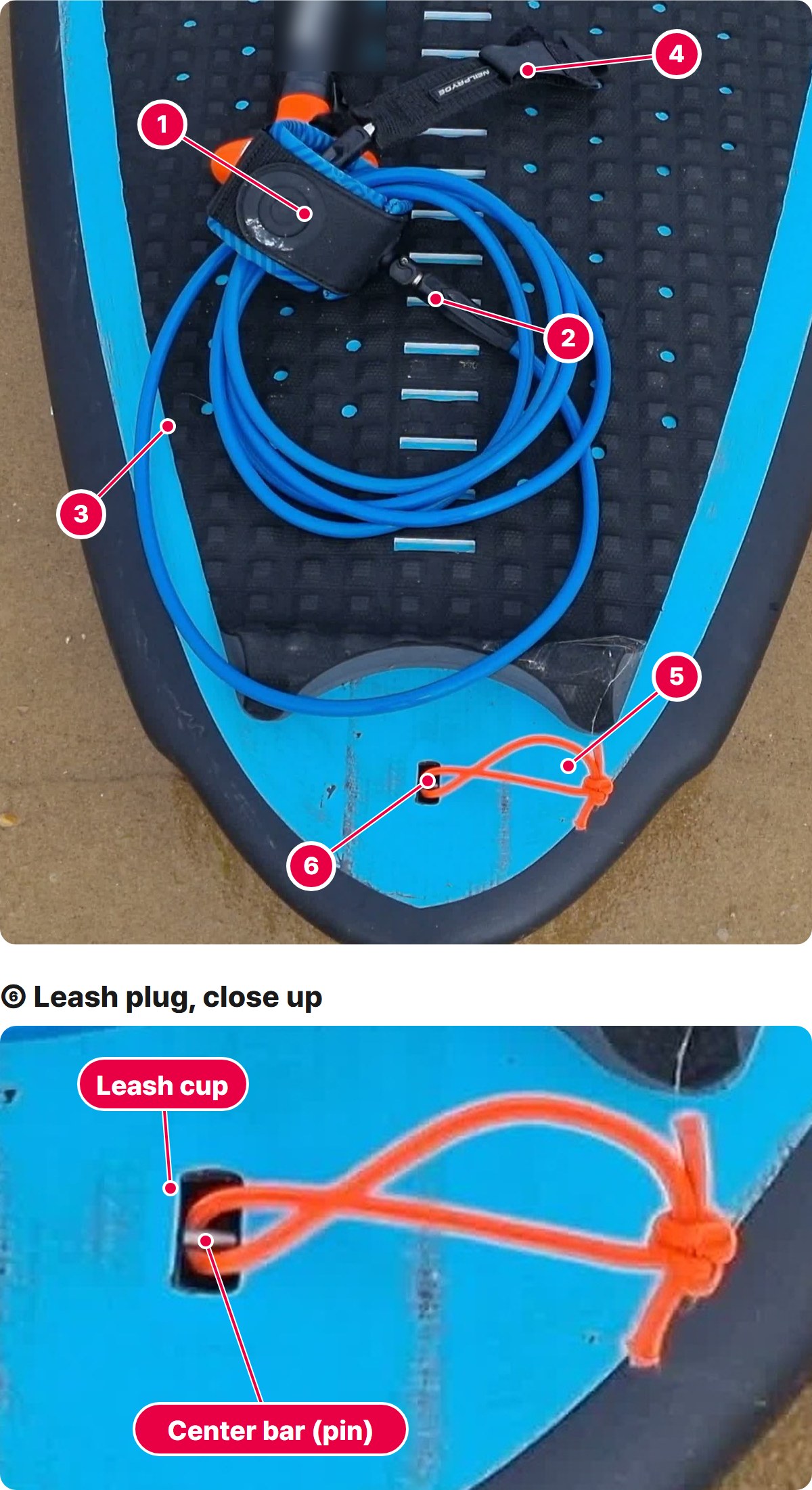
Here is how it is done in the field. It works just as well for SUP lessons. Learning the names of the parts first makes the rest easier.
Parts of a leash — from the cuff at your body to the leash plug on the board · Photo and labels: GO PADDLE
Once you know the parts, start at the board end.
Now for the body end. Compare the right way and the wrong way.
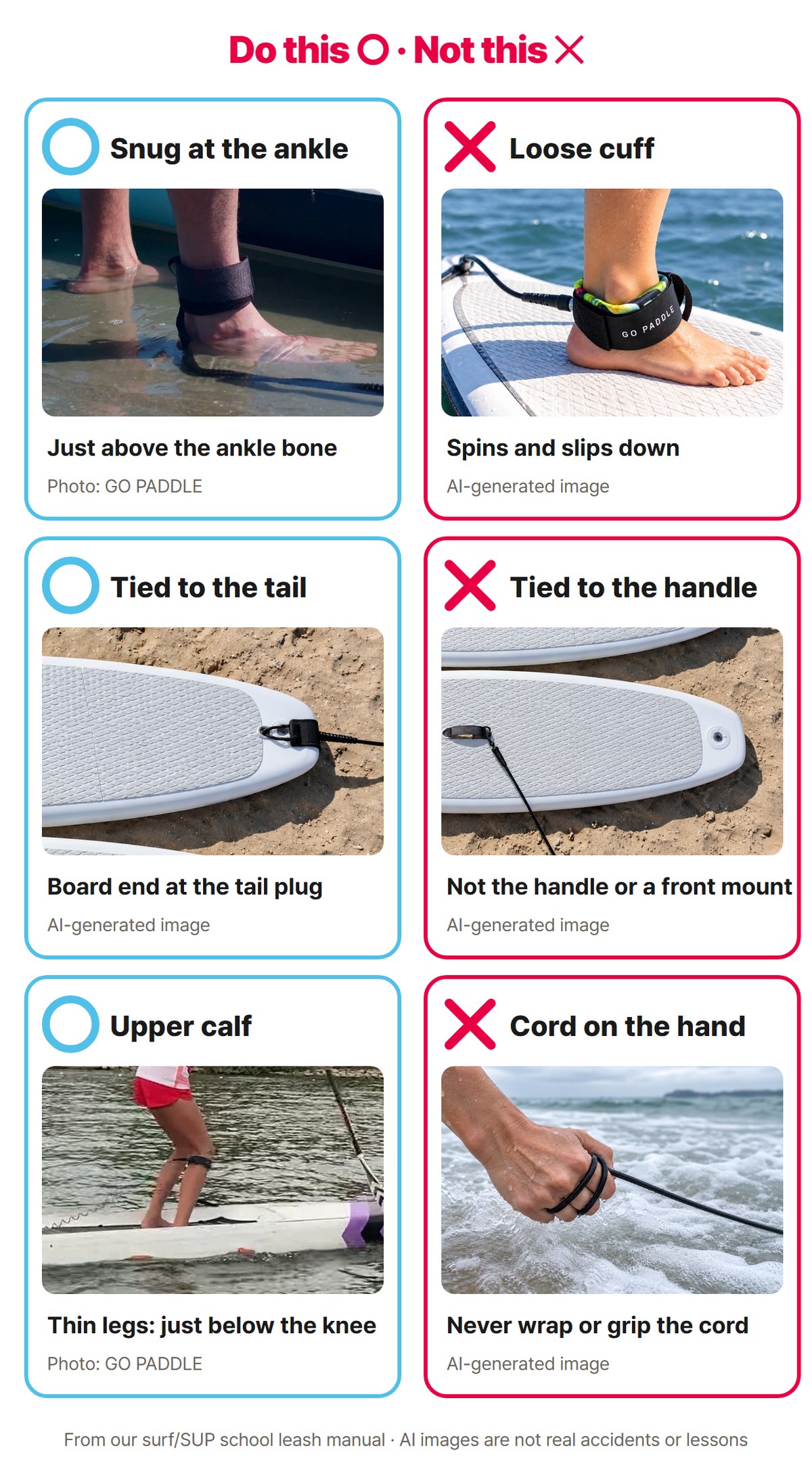
○ snug at the ankle · tied to the tail · upper calf / ✕ loose cuff · tied to the handle · cord around the hand · Photos: GO PADDLE (ankle, calf), others AI-generated
|
||||||||||||||||||||||||||||||||||||||||||||||||||
|
🚩 What SUP lessons often miss
In SUP lessons the leash often gets only a passing mention. Starting on calm water, it ends at "just put it on."
But if you take a SUP into waves, it's a different story. · Connect the board's tail to your ankle. If you wear it at the waist or below the knee when surfing a SUP, the force of the wave dragging a big, heavy board goes straight into your waist and knee, and can twist them into a serious injury. Attaching at the tail also reduces the drag on the board.
· Don't attach it to the handle or a front mount. In turn practice, stepping back near the tail means stepping on the leash, so some people clip it to the center handle or a front mount. Caught by a wave like that, the board is dragged sideways with great force. The leash can snap, or you can be hauled toward the board. The leash passes the force on the board straight to one point on your body.
American big-wave surfer Steve Rice broke his femur at Jaws, Hawaii, in 2021 when the leash yanked his leg as he fell. "The leash broke my leg instantly," he said (Duke Surf). It's an extreme big-wave case, but it shows that where you wear it on your body and where you attach it to the board changes how badly you can be hurt. |
||||||||||||||||||||||||||||||||||||||||||||||||||
📊 SUP accidents in numbers
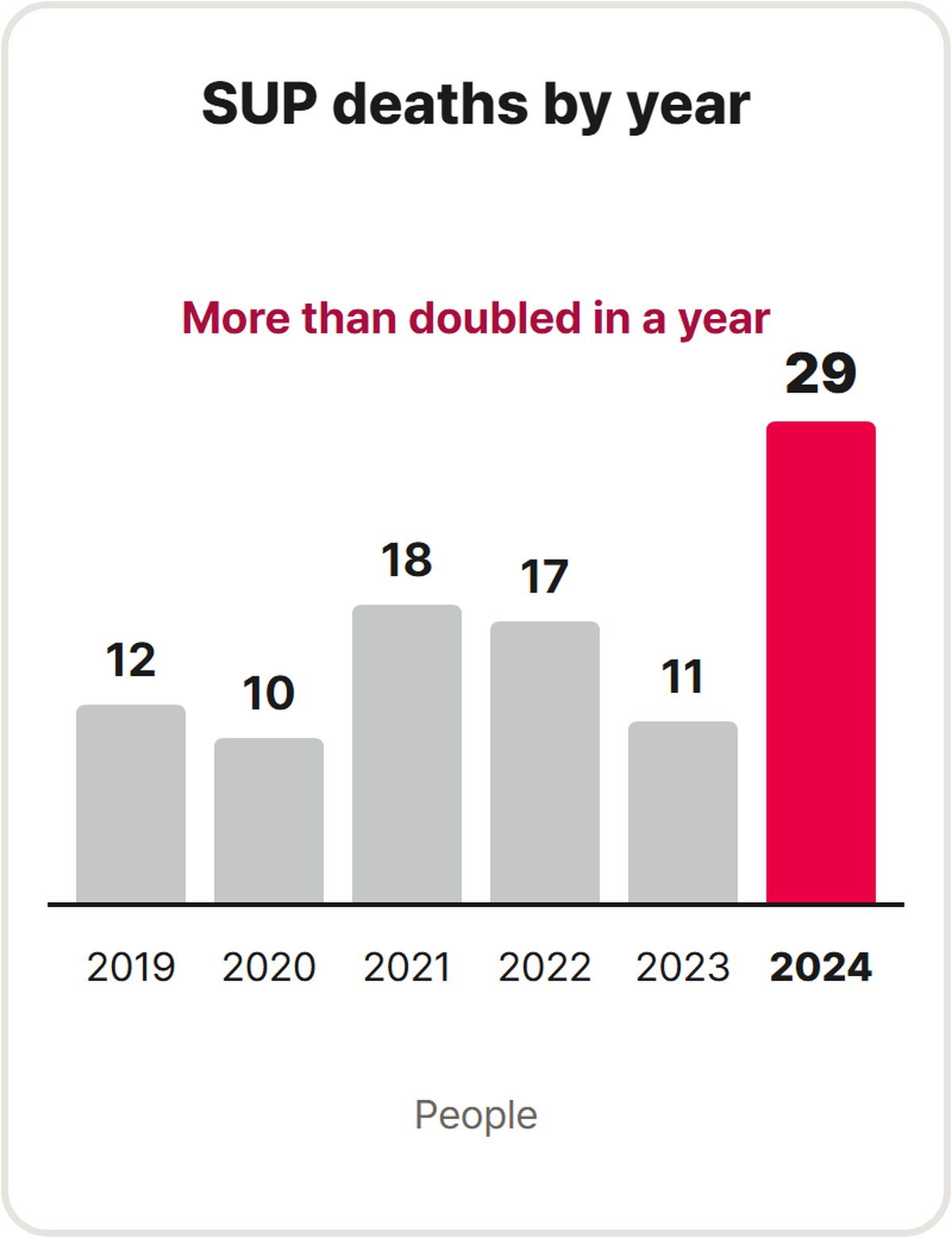
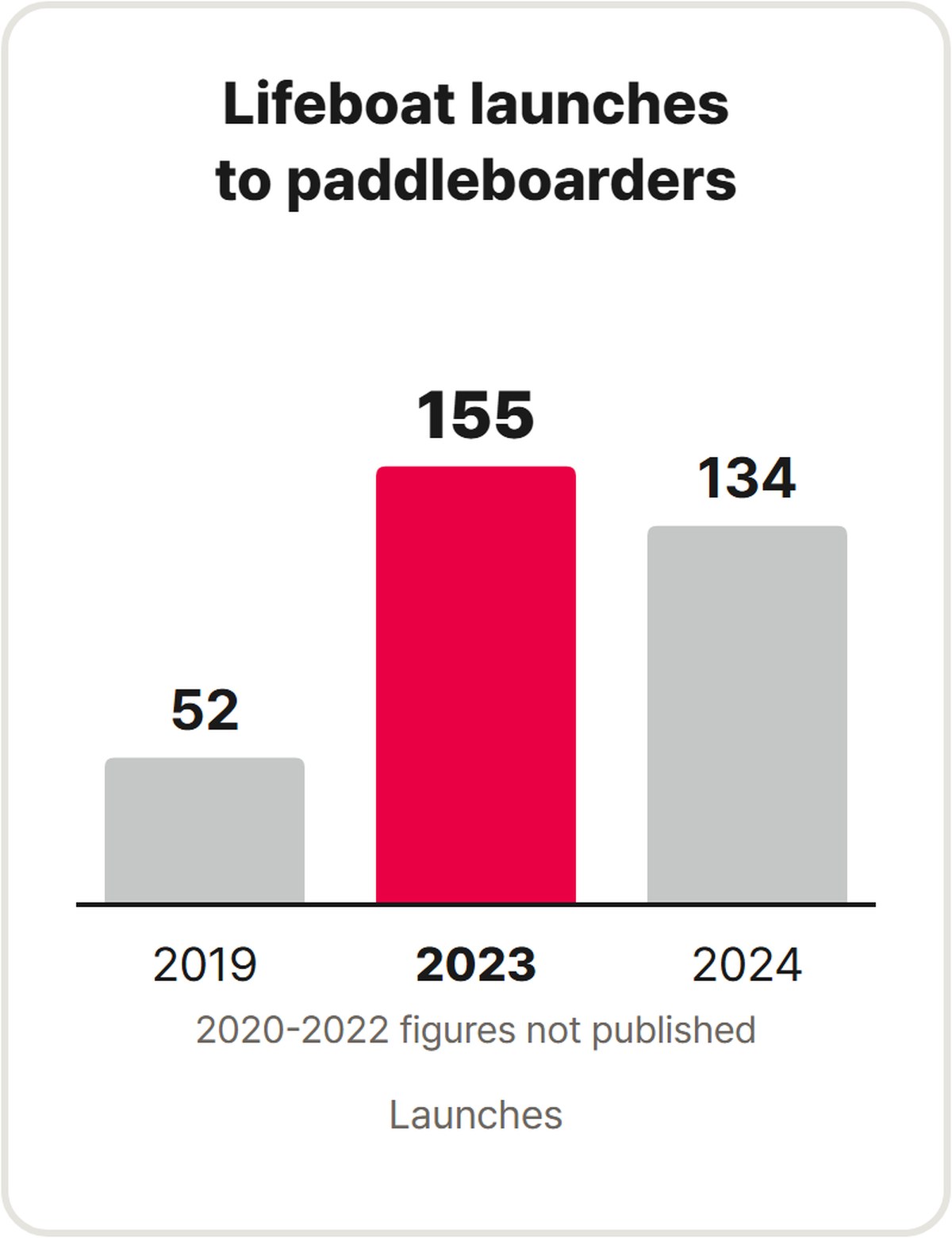
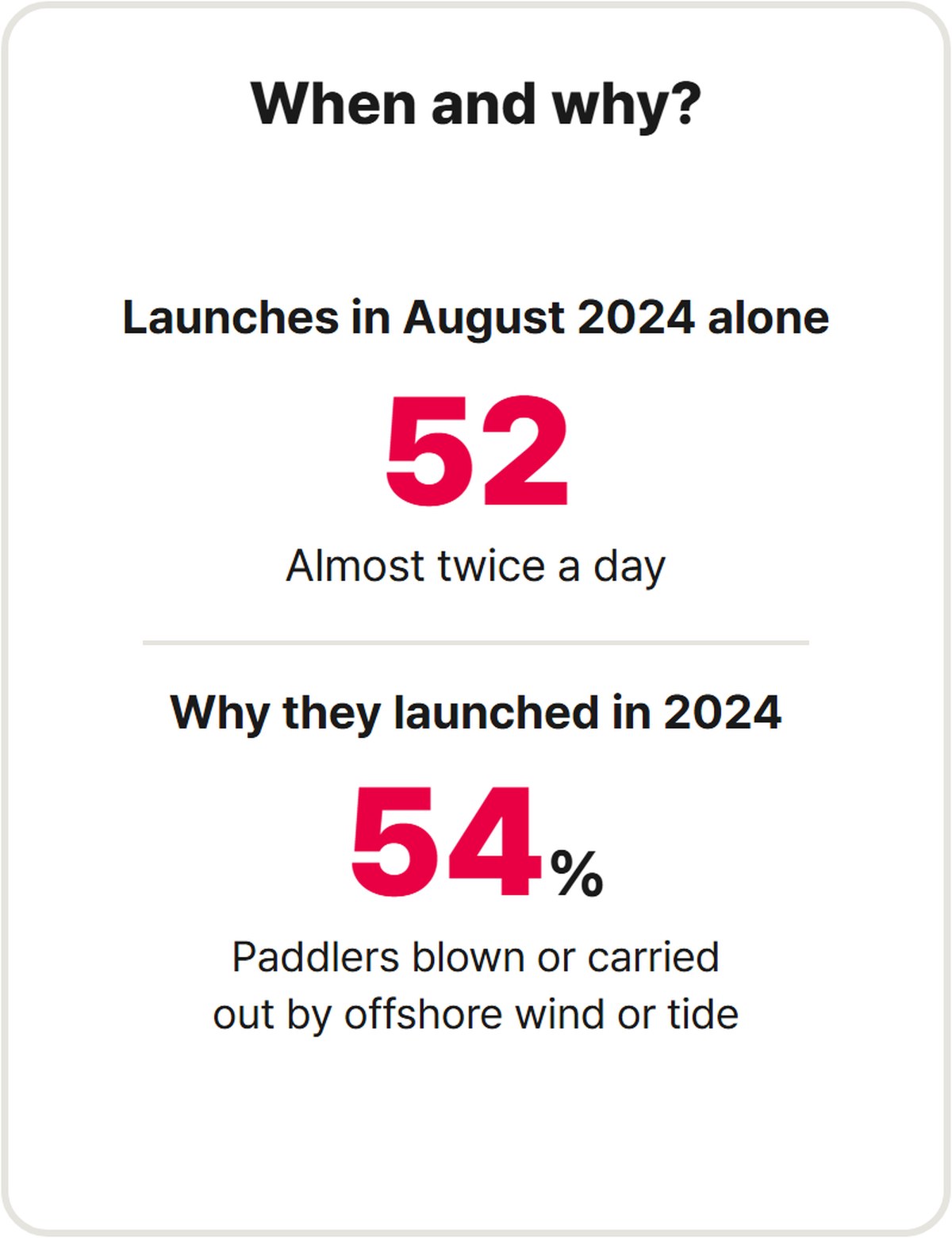
As SUP grows, so do accidents. Other countries count SUP accidents separately, so the trend shows up in the numbers.
 U.S. SUP deaths peaked in 2024
Source: U.S. Coast Guard Recreational Boating Statistics 2019–2024 · Chart: GO PADDLE
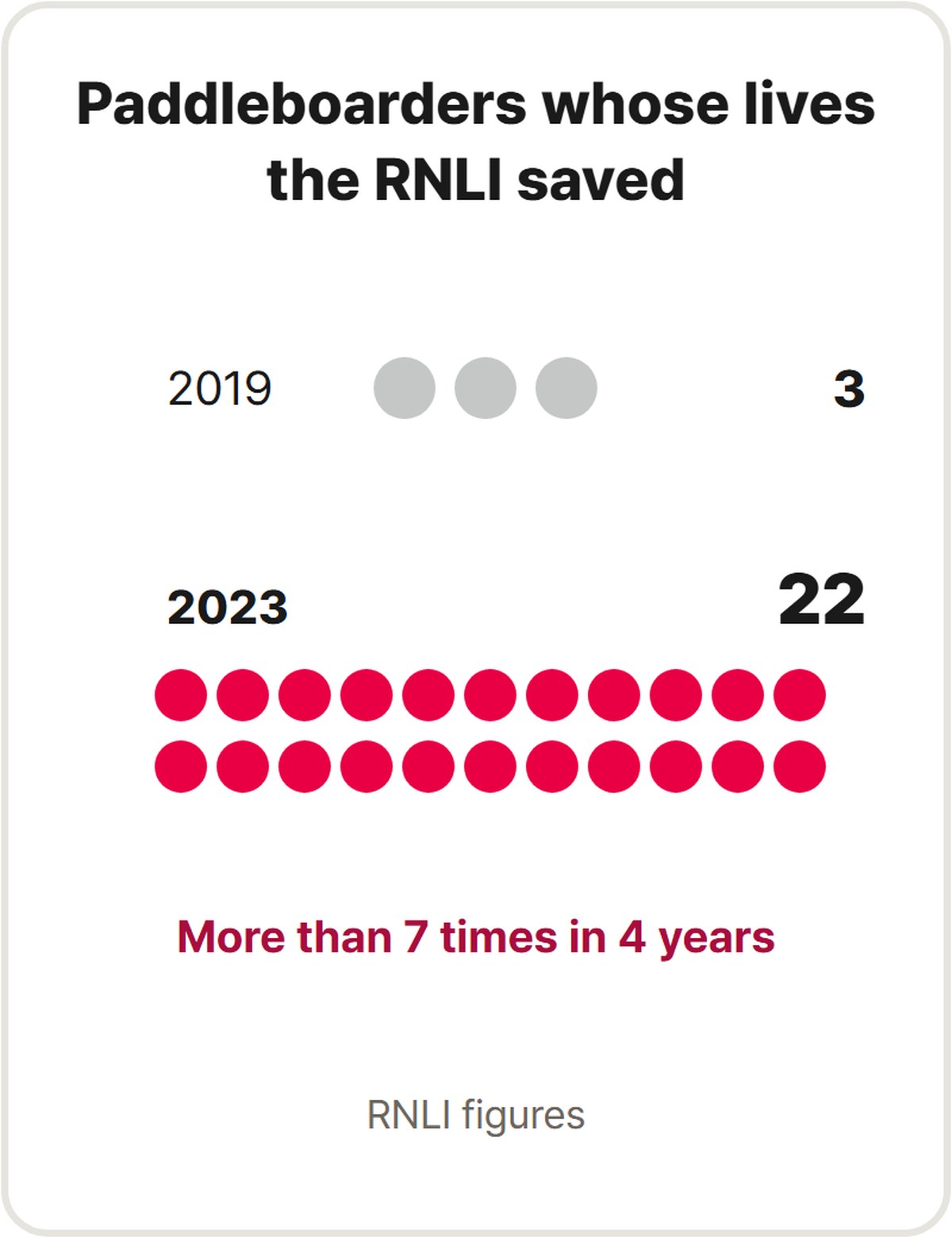
 UK lifeboat launches to paddleboarders tripled in four years
UK — lifeboat launches to paddleboarders (Royal National Lifeboat Institution, RNLI) · Sources: RNLI, June 2025 · RNLI, Aug 2024 · Chart: GO PADDLE |
||||||||||||||||||||||||||||||||||||||||||||||||||
|
🧑🏫 It looks easy — start with a lesson
SUP looks easy: stand up and go. That is one of its great strengths.
But as cheap inflatable boards have spread, more people buy online and head straight out with no safety training or beginner lesson. A sense of complacency ("it's calm, it'll be fine") and a safety gap (no one tells them) are growing together. Accidents usually start not with skill but with what people didn't know. In the U.S., 69% of recreational boating deaths involved operators with no boating safety instruction (among deaths where instruction was known; not a SUP-only figure). Paddleboarders being blown out by wind and tide and rescued by the coast guard happens every year. In Korea, the coast guard rescued 28 surfers and SUP paddlers near the shore in 2022 alone (Kukinews, Oct 21, 2022). One beginner lesson before the first paddle is the surest safety gear. Give a 10-minute local safety briefing (wind direction, leash, getting back on the board) even to customers who only rent a board, and encourage anyone who has bought a board to paddle alone to take a beginner lesson 🙏
|
||||||||||||||||||||||||||||||||||||||||||||||||||
 Korea's statistics have no SUP column So what about Korea? Hard to say. The Korea Coast Guard's official accident statistics have no separate column for SUP.
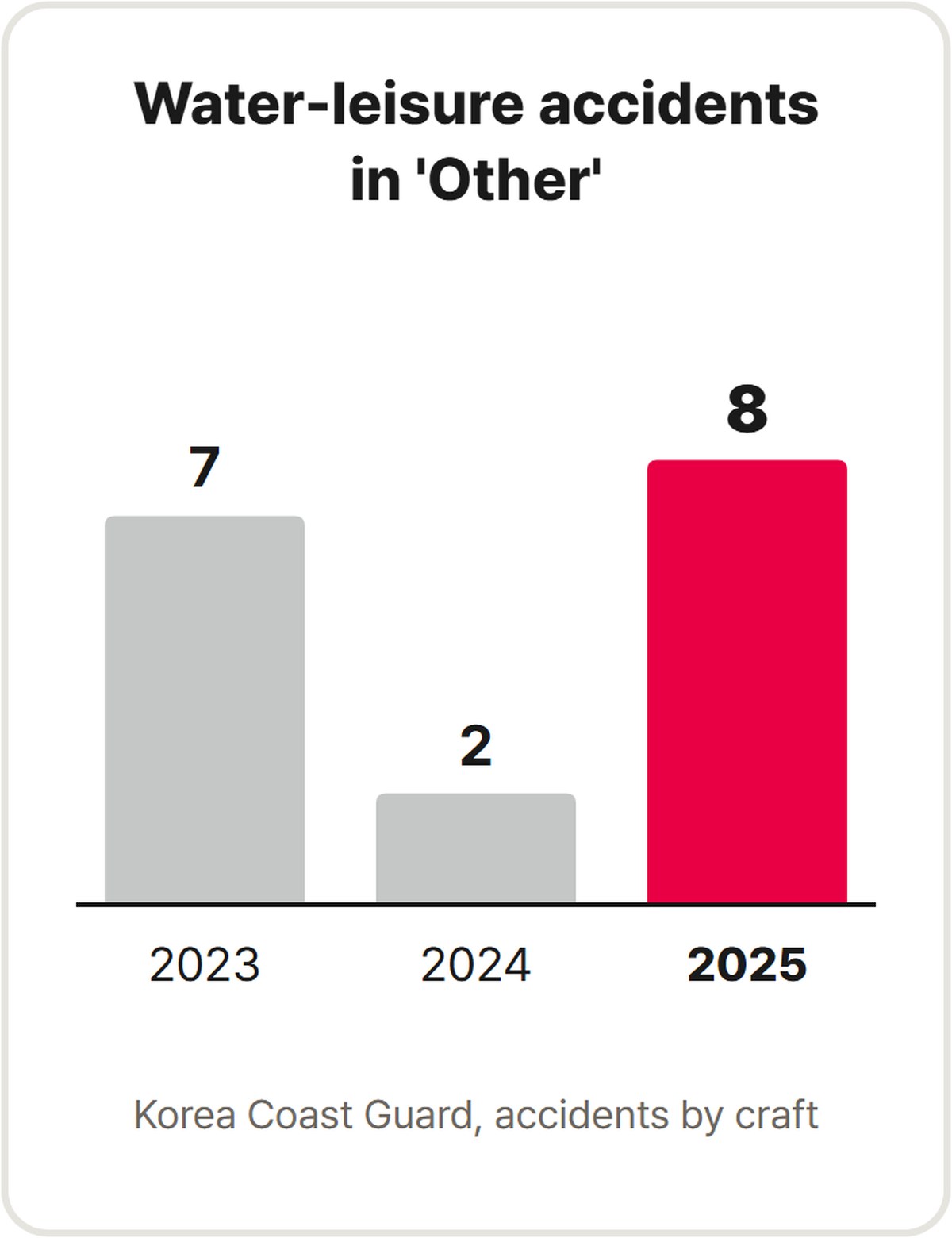
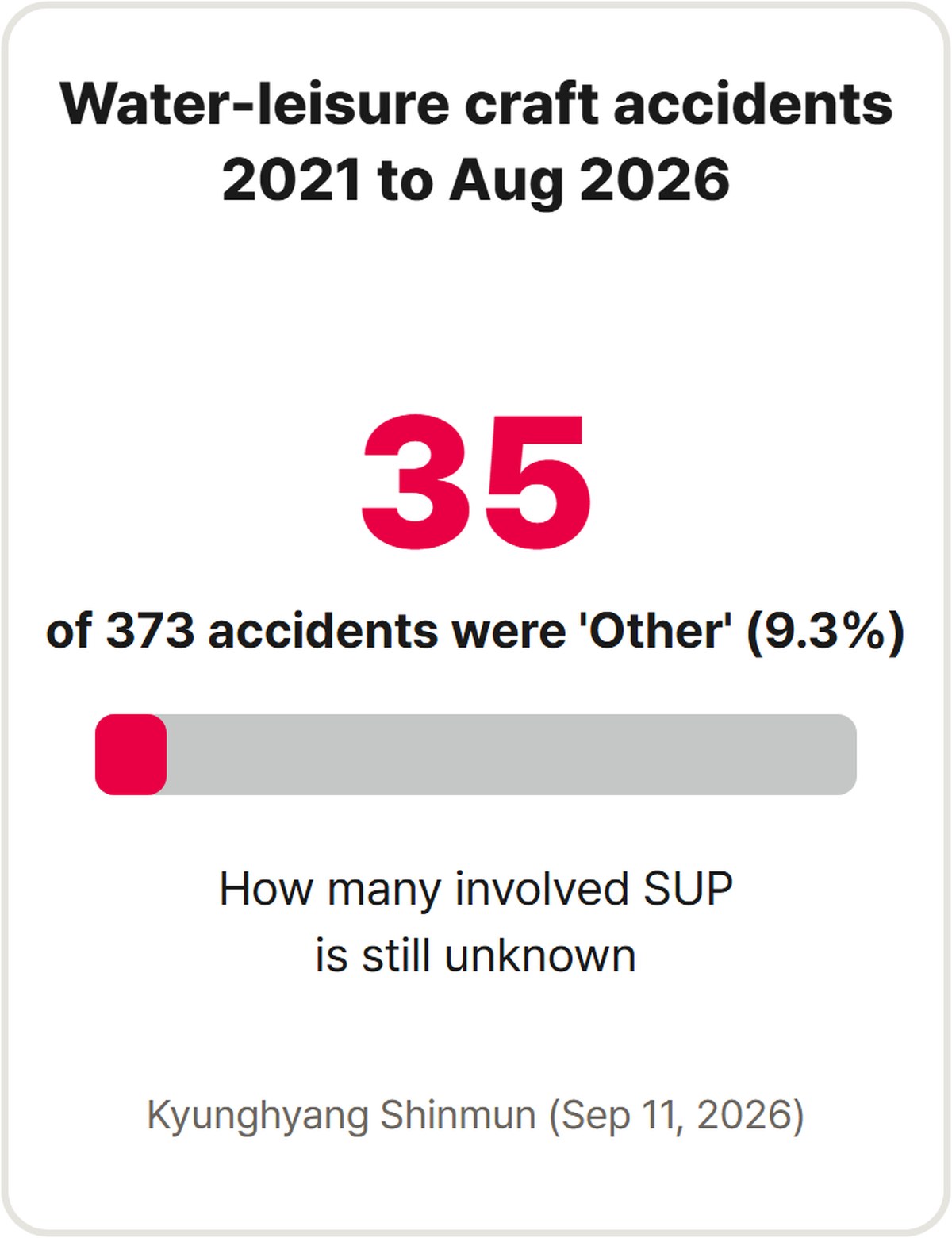
Water-leisure accidents by craft are split into motorboats, inflatable boats, personal watercraft, yachts and water sleds. SUP is lumped into "Other" with non-powered craft like kayaks, canoes and surfboards. In Korea's statistics, SUP is filed under "Other"
The numbers inside "Other" · Sources: Korea Coast Guard, water-leisure accidents by craft (Public Data Portal, 2025) · Kyunghyang Shinmun (Sep 11, 2026, Coast Guard data obtained by a lawmaker) · Kukinews (Oct 21, 2022) · Chart: GO PADDLESurfboards registered at water-leisure businesses alone have grown more than twentyfold in ten years, yet the accident statistics still don't count surfing or SUP separately.
If we don't know how many accidents happen, we can't know what to fix. The Korea Coast Guard needs a process that counts non-powered craft separately as SUP, kayak, canoe and surfboard, and records whether a leash and a buoyancy aid were worn in each accident. |
||||||||||||||||||||||||||||||||||||||||||||||||||
|
⚖️ Korean law defines the leash as an "ankle" leash
Korean law mentions the leash. Article 23 of the Enforcement Rules of the Water Leisure Safety Act requires a life jacket for water leisure, but lets surfboards and SUPs use a leash instead.
And it defines that leash like this:
Kayaks and canoes have no such exception, so a life jacket is required. Only SUP and surfing can use a leash in place of a life jacket.
A life jacket is more uncomfortable to paddle in than you might think. Paddling means swinging your shoulders and arms wide, and the vest catches around the shoulders; every stroke twists your torso, and the vest resists, making you stiff. It squeezes your chest and stomach, making deep breaths hard. So unless you're a weak swimmer, on a SUP a leash suited to the water in place of a life jacket is the practical choice. That's where the saying "SUP needs an ankle leash" comes from. The law makes no distinction by water. Lake, surf or river, it's the same "ankle" leash.
The overseas research and official advice we've seen warn against exactly that ankle leash on moving water. There's a gap between the law and the latest field research. The field can close that gap before the rules change. Start by checking which leash suits the water at your own school. 🏙️ The Han River is calm, but there's a weir at each end
The water-leisure zone on Seoul's Han River runs from below Jamsil Bridge to Haengju Bridge, with the Jamsil and Singok submerged weirs at each end.
Normally the Han is close to calm water, but around the weirs, or when more water is released from Paldang Dam upstream, it becomes moving water. Seoul halts non-powered craft when Paldang releases exceed 1,500 tonnes per second. 
In August this year, a swimmer in his 30s was swept into the eddy at the Jamsil weir and found in cardiac arrest, with the rope of a rescue tube wrapped around his body (YTN, Aug 3, 2026).
It wasn't a SUP accident, but it shows what can happen when you meet an eddy with a line attached to your body. Seoul is now drafting new Han River navigation rules. As Han River Bus services have grown and cruise boats, motorboats and work boats share the river, existing laws are too general, so a unified standard suited to the Han is needed. The draft was published for comment in August (Yonhap via Supple, Aug 23, 2026).
And the law already lets the river's managers decide which safety gear must be worn, by type of activity, craft and weather (Enforcement Rules, Article 23(2)). Now is the time to put the latest research into the rules on the water. GO PADDLE has watched the river alongside the instructors and operators who teach and guide on the Han. We hope its rules will fit real conditions on the water, and we leave a few requests from the field.
|
||||||||||||||||||||||||||||||||||||||||||||||||||
|
📚 Past issues
💬 Suggest a topic
Was this forwarded to you?
📩 Subscribe (Korean)
|
||||||||||||||||||||||||||||||||||||||||||||||||||
|
Sources · Paddling Magazine (Oregon 2026) · Philomath News (Pomeroy) · Paddling Life (Pomeroy) · CPS (Haverfordwest sentencing) · MAIB investigation report · British Canoeing (2023 tests) · Paddle UK (choosing a leash) · USCG 2024 statistics · RNLI (June 2025) · RNLI (Aug 2024) · NRS (leashes) · Coroners Court of WA (Margaret River) · Stab Mag (Margaret River) · Insight (Yangyang, Aug 2023) · Water Leisure Safety Act Enforcement Rules, Art. 23 · YTN (Jamsil weir, Aug 2026) · Lodestone Leashes · Paddler's Guide (Lodestone) · Stab Mag (Florida finger injury, May 2025) · Ruijs et al. (2015) surfing hand injuries · Medical Daily (Gangneung Asan Hospital, Aug 2024) · Stab Mag (Derek Hynd interview) · Wikipedia: Surfboard leash (Jack O'Neill) · SupConnect (leash string) · evo: How to Choose a Surfboard Leash · Duke Surf (Steve Rice) · Korea Coast Guard accident data · Kyunghyang Shinmun (Sep 11, 2026) · Kukinews (Oct 21, 2022) · Yonhap via Supple (Han River rules, Aug 23, 2026) · Twemoji flags (CC BY 4.0) · Oregon State Marine Board (Jul 2024)
|
||||||||||||||||||||||||||||||||||||||||||||||||||
| GO PADDLE gathers news for instructors and operators in non-powered water sports — canoe, kayak, SUP, surfing and wing foiling. | ||||||||||||||||||||||||||||||||||||||||||||||||||
|
||||||||||||||||||||||||||||||||||||||||||||||||||
| ▲ Top | ||||||||||||||||||||||||||||||||||||||||||||||||||
| GO PADDLE 고패들 | ||||||||||||||||||||||||||||||||||||||||||||||||||
| GO PADDLE Newsletter · October 27, 2026 | ||||||||||||||||||||||||||||||||||||||||||||||||||